Targeted Condition Assessments Prioritize Temple's Water Main Replacements
Water utilities often rely on risk models to determine which water mains should be prioritized for replacement. But what happens when a pipe identified as high risk is actually in better condition than the model predicts?
A municipal utility in Temple, Texas, explored that question by pairing its predictive risk model with targeted in-line condition assessment using Advanced Vibroacoustic Analysis (AVA), powered by Kenwave's DRI.
The Challenge: Turning Risk Scores Into Confident Decisions
The City of Temple developed a water main risk model that evaluated both the consequence of failure and the likelihood of failure.
The consequence of failure was scored from 1 to 5 based on factors including:
- Pipe diameter and depth
- Maximum daily demand
- Proximity to water bodies, railroads, roads, and water facilities
- Critical customers and potential service impacts
Likelihood of failure was also scored from 1 to 5 using factors such as:
- Pipe material
- Age
- Repair history
- Soil corrosivity
The two scores were combined to create an overall risk score ranging from 1 to 25. Water mains with scores of 20 or greater were then screened for inspection feasibility and considered for targeted condition assessment.
This approach created a logical starting point: use the risk model to identify the pipes most in need of attention, then gather direct condition data to determine whether those pipes actually require replacement.
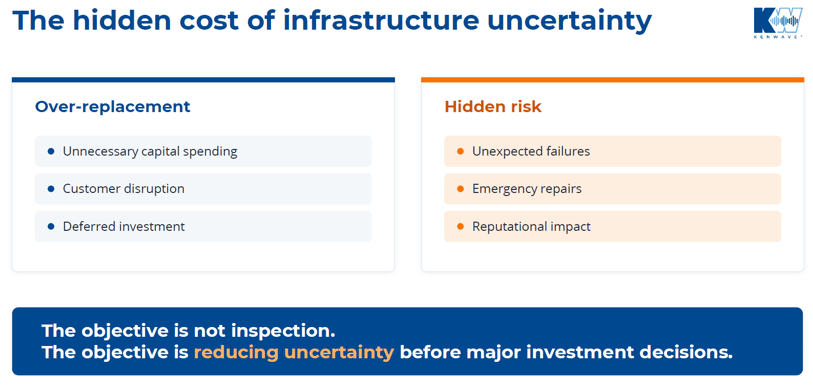
Developed by KenWave, this graphic highlights the hidden costs of infrastructure uncertainty and why utilities need better information before making major investment decisions.
The Approach: Looking Inside the Pipe
The City of Temple selected 47 water main segments for assessment using Advanced Vibroacoustic Analysis (AVA), a non-invasive technology that evaluates pipeline condition by identifying areas of reduced pipe wall stiffness and potential structural deterioration.
The inspections covered:
47
water main segments
12,355 LF
of water main assessed
6- to 16-inch
pipe diameters
Residential + Commercial
service areas
Rather than assessing the entire distribution system, the utility focused on the highest-risk, inspection-feasible segments identified by the predictive model.
This targeted strategy allowed the utility to add observed condition data where it could have the greatest impact on capital planning decisions.
The Model Identified the Right Pipes, but Not Always the Right Priority
The inspection results revealed an important distinction between predicted risk and observed condition.
Of the 47 inspected segments:
- 31 segments (66%) remained in their original risk category.
- 16 segments (34%) dropped by one or two risk levels after incorporating condition data.
- 0 segments increased in risk.
In other words, the predictive model successfully identified pipes that warranted attention, but condition assessment showed that one-third could potentially be lower priority than the risk model alone indicated.
That one-directional result is significant for capital planning. Overestimating risk can lead to a water main being replaced earlier than necessary, consuming capital that could potentially be directed toward assets with more immediate needs. Underestimating risk, on the other hand, can leave a deteriorated main in service longer than intended and increase exposure to unplanned failures, service interruptions, water loss, and emergency repair costs.
From Risk Ranking to Better Prioritization
The results demonstrate that predictive risk modeling and condition assessment need not be competing approaches.
Instead, they can work together. The risk model provided a systematic way to screen the distribution system and identify candidate assets. Condition assessment then added another layer of information, helping the utility distinguish between pipes that warranted continued priority and those that could potentially be deferred.
That distinction matters when utilities are developing multi-year capital improvement programs.
Rather than treating a risk score as the final answer, utilities can use targeted condition assessment to calibrate their models, increase confidence in replacement decisions, and better sequence capital improvements.
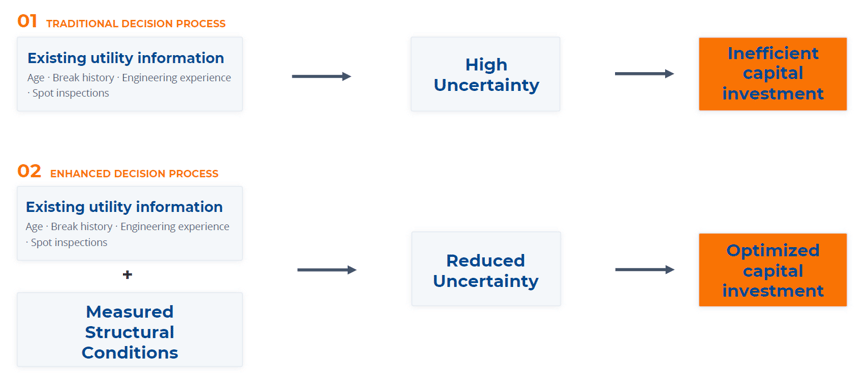
Developed by KenWave, this graphic illustrates how incorporating measured structural conditions into existing utility data can reduce uncertainty and help utilities make more informed capital investment decisions.
Why what RJN does matters to you
For utilities managing aging water infrastructure, the question isn't simply which pipes have the highest predicted risk. It's whether the available data are sufficient to support a confident investment decision.
Targeted condition assessment can help answer that question.
By combining predictive risk factors with direct information about pipe condition, utilities can:
- Validate the assumptions behind their risk models
- Identify assets that may be healthier than predicted
- Focus replacement funding on mains with the greatest demonstrated need
- Reduce the potential for premature replacement
- Build greater confidence in capital improvement priorities
- Develop a more defensible, data-driven replacement strategy
The Temple case study demonstrates how condition data can add an important dimension to risk-based planning. The predictive model successfully identified candidate mains for further evaluation, while AVA provided additional information that helped refine the prioritization of those assets.
The Bottom Line
Risk models tell utilities where to look. Condition assessment can help determine what to do next.
For utilities facing growing infrastructure needs and constrained capital budgets, combining predictive analytics with targeted condition assessment enables replacement decisions based on both risk and actual conditions inside the pipe.